Showing posts with label Oral Knowledge. Show all posts

Sunday, October 30, 2011

Why did Plato write??


Medieval portrayal of Socrates and his greatest pupil, Plato.


"The safest general characterization of the European philosophical tradition is that it consists of a series of footnotes to Plato. I do not mean the systematic scheme of thought which scholars have doubtfully extracted from his writings. I allude to the wealth of general ideas scattered through them."
A. N. Whitehead, Process and Reality, p.39

    If you think about philosophy, it's about as dependent on writing as math. Formulating thoughts in the air is nearly impossible for me, and certainly impossible  for anyone else to understand (just think of how much harder it is to spell a word out loud than to write it down-- in a spelling bee I'd be thinking,"I could do this if i had a pen and paper..")

      However, we do know that Socrates didn't write a line of his thoughts, and he's considered the father of Greek philosophy and modern thought! We only know the things he said indirectly, kind of like how we have the teachings of Jesus Christ though we don't have his direct account--in this way the two have often been compared, because it has only been through the records of others that we know anything of them.  

     The written word, to Socrates, was as a child without a father: unable to protect itself. He said that writing is deceptive like a painting-- paintings portray things that are falsely living and can't answer questions, just as books can indicate things but cannot give further explanation or answers to questions. Once a man writes down his thoughts, he loses control of them, soon his words become a toy for everyone to play with--written words are vulnerable to having their true meaning lost to them. Socrates had no school, no books, he preferred to a "living" philosophy made of conversation with people he met on the streets. Philosophy was to be made in common with others, the research was made orally. So, even though in our minds philosophy is often represented by great literary works (Kant, Hegel, Descartes...), philosophy is not so clearly related to literacy.

     If Socrates was so opposed to writing, as we talked about in class, and he indoctrinated that belief into his greatest pupil, Plato, why, then, did Plato write?? 

Wednesday, October 12, 2011

Reflections...

True or False??
Well after the Oral Knowledge final that we had on Tuesday, I feel as though I would be amiss if I didn't centre my thoughts on the great thing which we all participated in. If I had been asked beforehand whether I thought this would actually help me understand the value of oral knowledge, i'm pretty positive that my answer would have been along the lines of NO. There's always a first for everything and I was proven wrong in this case.
It's been great to see the different blog posts from all the all the many different civilizations and see the connections that have been found as they pertain to oral knowledge. One thing that has been hard for  personally, is to find a way in which I can relate things to my own life when learning about something that existed 3 thousand years ago. I believe that because of that aspect there, the presentation of King Benjamin's speech taught me many things because of how personal it is to me and my life.
So from the final that we took, there are a few things that jumped out at me as we were all doing our recitations as to why I think Oral Knowledge is unique. I'll try and share a few.


Saturday, October 8, 2011

Psalms- Remembering Jehovah through Song


When I was looking for some ancient Hebrew oral subjects I thought I wouldn't be able to find anything. Then I realized that it was staring me in the face. Probably the most famous songs in Christian history the book of Psalms are a perfect example of oral expression in Hebrew culture.


Psalm 8 sung in Hebrew


It is important to recognize that the psalms are not doctrinal statements, creeds, or history but that they are both poetry and prayer, poetry intended to be set to music and prayed in worship. In ancient Israel, no less than in the modern world, poetry and music were the means by which people expressed the deepest of human feelings and emotions, the most profound of insights, and the most tragic and joyous of human experiences. It is no accident that after Israel’s deliverance from Egypt on the banks of the Reed Sea the people sang (Exod. 15:1-18)! Or that Hannah lapses into song at the dedication of Samuel (1 Sam. 2:1-10; note Lk. 1:46-55)! Or that David mourns Saul and Jonathan in a beautiful poetic elegy (2 Sam. 2:19-27). Much of the language of the Psalms is metaphorical and symbolic, the language of the poet.

The Psalter, as the Book of Psalms is often called, is actually a collection of different kinds of poetry spanning many centuries of history (from c. 1100 BC, Pss. 29, 68, to c. 400 BC, Ps. 119) and reaching essentially its present form around 300 BC. Evidences of the collective nature of the Psalter are seen in its division into five 'books' (for example, Ps. 72:20), the references to various authors (for example, Psalm 89), as well as the different time periods represented (Ps. 137 is clearly from the period of Exile, c. 550 BC).


In biblical worship, the psalms were chanted or declaimed. We do not know exactly how this music sounded, though recent research has confirmed the similarity between Hebraic music and ancient forms of Christian chant. (See the article on Music and Worship in the Bible on this web site.) The psalms formed part of the developing liturgy of the Eastern and Western churches, along with Greek and Latin hymnody. In the Western church, the psalms found more regular usage within the "offices" or daily periodic worship of the monastic communities. The Catholic heritage of chant, often called Gregorian chant because of the influence of Pope Gregory the Great (540-604), includes the use of the psalms sung to standard "tones" or melodies according to conventional rules. This music was performed by choirs of clergy or members of monastic orders, who had developed the necessary skills. Originally the psalms were sung monophonically, i.e. with one unharmonized melody, or "plain chant." In the later Middle Ages additional voices were introduced, with such devices as counterpoint (a different simultaneous melody) or organum (a sustained tone over which others sang the melody). The departure from the simpler form of chanting was opposed by those who believed that more elaborate musical detail called attention to the performance and thus degraded the worship of God.

This early psalmody was exclusively vocal. It is paradoxical that the psalms, which so often mention the use of musical instruments in the praise of God, were sung for centuries in the church without any instrumental accompaniment. Today both the Eastern Orthodox churches and some Reformed and other Protestant groups exclude musical instruments from use in worship.

Cited works:

http://www.crivoice.org/psalmsintro.html


Friday, October 7, 2011

Center and Edge--

This is just a response to the last couple posts about oral knowledge. As I've been commenting on everybody's posts I realized I was writing the same things as I have a couple times before ("it's interesting that cultures rise and fade, why do they do this?" sort of thing), then realized why I was on that one-track train.  As I've read these posts, I can't help but think back to Orson Scott Card's Children of the Mind. In the afterward of the story, he comments on an idea sparked by a Japanese writer, Kenzaburo Oe: some nations are at the center of the world, while most fall into the hole of being an edge nation.

Thursday, October 6, 2011

The Gothic Language Continued...

I attempted to find an "expert" on the gothic language by turning to german professors at various institutions. But in turns out that the gothic language is extinct so there aren't too many experts on the language...(or no one wants to help out a poor freshman).

However, I did find this video where a man is speaking (or at least attempting to speak gothic-- as no one really knows what it sounds like) gothic. He is reading the story of the prodigal son in Luke. All of the written gothic language is from the copies we have of the bible. Start at 4:17.


From how the guy in the video is speaking the gothic language, it sounds quite a bit different from the German language as we know it today. Since I don't have insight from a gothic language expert, my brother-in-law (who I've referenced before... he's a German literature major) let me film him reading the story of the prodigal son, Luke 15:11-17...

(pretend this is a video of Chris speaking German....it's taking eons to upload...it will be on soon!)

As I watched the first video in Gothic and the second in modern German, it made me think how languages can evolve and branch off-without any deliberate effort. Why didn't humans start speaking the same language? It started me thinking. I did some research on it and I thought these quotes are interesting...


"In 1866, a ban on the topic was incorporated into the founding statutes of the Linguistic Society of Paris, perhaps the foremost academic linguistic institution of the time: ‘The Society does not accept papers on either the origin of language or the invention of a universal language."

Evolutionist Carl Zimmer said this on the origin on language:

"No one knows the exact chronology of this evolution, because language leaves precious few traces on the human skeleton.  The voice box is a flimsy piece of cartilage that rots away.  It is suspended from a slender C-shaped bone called a hyoid, but the ravages of time usually destroy the hyoid too."

Just as we have no information on the sounds of the Gothic language, we really don't have that much information on the topic of oral language itself. There is no physical evidence of language-once said, it disappears- unless written down. There is this sort of mysteriousness with oral language as we never really know the exact way it came to be and how there can be many different languages, and how languages can die off.


Sources: 1, 2

Wednesday, October 5, 2011

Written vs Oral- The Hittites

To go along with the Functions and Systems of Oral knowledge that we have been assigned to study I want to focus on ways that oral knowledge differs from written knowledge and how these distinctions make it unique.
We have talked in class how there is a hybrid between these two systems and that there's quite a large cross over, but in the same light there are also many things that make them both unique and important in their own ways.

Monday, October 3, 2011

Ovid, Metamorphoses, and High School Musical


Ovid nomen meum!  My name is Ovid!

      The Roman Republic was on it's last leg when Ovid, creator of the epic poem Metamorphoses, was born. One year before Ovid's birth, Julius Caesar was assassinated in the Roman Senate as problems withe the now 500-year-old Roman Republic were coming to a head. An intense struggle for the control of Rome between Julius Caesar's former friend/supporter Mark Antony and Julius Caesar's grandnephew/heir Octavian began, eventually ending with Octavian taking power, becoming Rome's first emperor-- Octavian would rule for almost all of Ovid's life. 

       Ancient Rome, as most ancient cultures, revolved around oral tradition. ("Hey Ovid, wanna memorize and recite some Homeric epics with me??" "Curabitur ut tortor dude!") Unfortunately, Ovid wasn't as good at oratory as was his older brother. Like most younger siblings who simply choose to explore another skill rather than live in the shadow of their stellar older brother/sister, Ovid developed a love for poetry.....

          Ovid joined a circle of poets, working with the best of the best in Rome. He attended poetry readings by Propertius and Macer, reported that the group was enthralled by Horace, and said he even saw Virgil once. He read his own poems in public by the time he was eighteen, and was soon recognized as a rising star. 

             Metamorphoses is Ovid's best known work, a twelve-thousand-line poem divided into 15 books. This Latin epic draws on Greek Mythology and Roman legend, telling of "transformations" from the creation of the world to the time of Octavian. At the end of his poem, Ovid prophecies that "I shall be the one whom people hear and read. And if poets truly can foretell, in all centuries to come, I shall live." Considering the survival and widespread popularity of his work throughout the ages, Ovid's right!

Saturday, October 1, 2011

Semites- More Than Just Jews

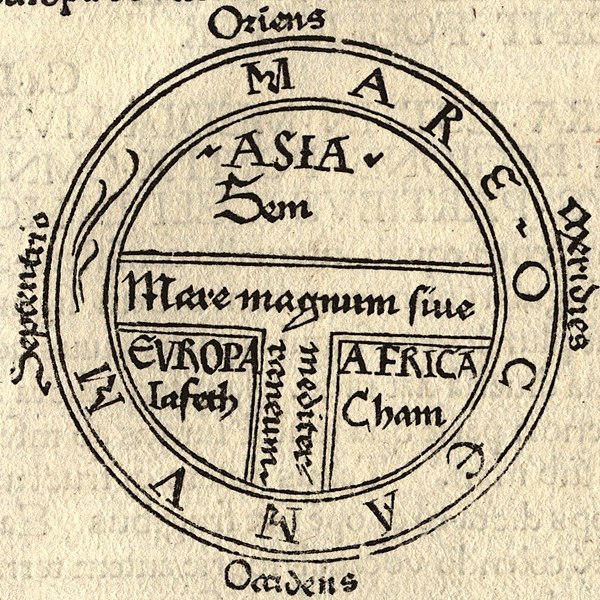
A stylised T and O map, depicting Asia as the home of the descendents of Shem (Sem). Africa is ascribed to Ham and Europe to Japheth


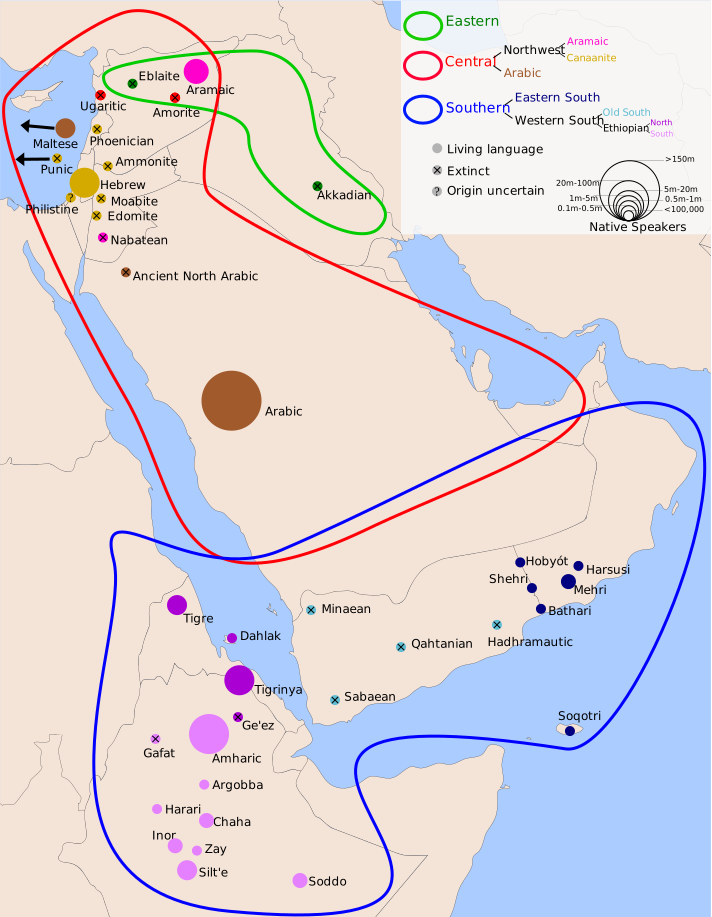
Map showing the distribution of Semitic languages


When I first learned that my blogs were to be on the Semitic civilization I thought that it would be pretty easy. I mean, when a person thinks of Semites they think of Jews don't they? But when I did a google search I was surprised what I found. Semites not only refer to Jews but to they whole region of Mesopotamia and Arabia. It turns out that the stereotype of only Jews being Semites is very recent.


The term Semitic was first suggested by German scholar Ludwig Schlozer, to signify languages that were closely related to Hebrew. The word "Semitic" is an adjective derived from Shem, one of the three sons of Noah in the Bible. The idea of "Semitic: peoples is derived from Biblical accounts of teh origins of the clutrues known to the ancient Hebrews. Those closest to them in culture and language were generally deemed to be descended from their forefather Shem. Enemeis were often said to be descendants of his cursed nephew, Canaan. In Genesis 10: 21-31, Shem is described as the father of Aram, Asshur, and Arpachshad: the Biblical ancestors of the Arabs, Arameans, Assyrians, Babylonians, Chaldeans, Sabaeans, and Hebrews, etc., all of whose languages are closely related. (Try saying this list out loud, you run out of breath pretty fast.)

The term "anti-Semitic" pretty much refers to Jews only. It was first used in 1879 by German journalist Wilhelm Marr in a pamphlet called, "The Victory of Germandom over Jewry." Marr argued that Jews who had Judaized Geramans beyond salvation. In 1879 marr founded the "League for Anti-Semitism".


Friday, September 30, 2011

Celts and War--

The Celts were people of war. They charged into battle naked, dyed themselves (all of themselves) blue, and screamed like Comanches. They cut off heads of their foes and stuck them on their walls or belts. It would make sense then that much of Celtic oral tradition follows the triumphs and falls on the fields on battle.

Wednesday, September 28, 2011

Uriah?


     To pick things up with our Oral Knowledge unit and also focusing on the topics my group has been given, I'm going to start of with a knowledge test...of sorts.

     We are going back to the early Bible times on this one...hypothetically speaking, lets say you were a descendent of Heth, which would make you part of the second tribe of the Caananite nations. You live in a place called Anatolia (see map for general region) which is basically the present day Lebanon and your culture was eventually dissolved into a variety of others as your empire crumbled and your language is now obsolete. 

     If you could tell me what the name of your civilization is or i guess what it was, then well....you deserve an A i suppose!

Read more to find out if you were right...