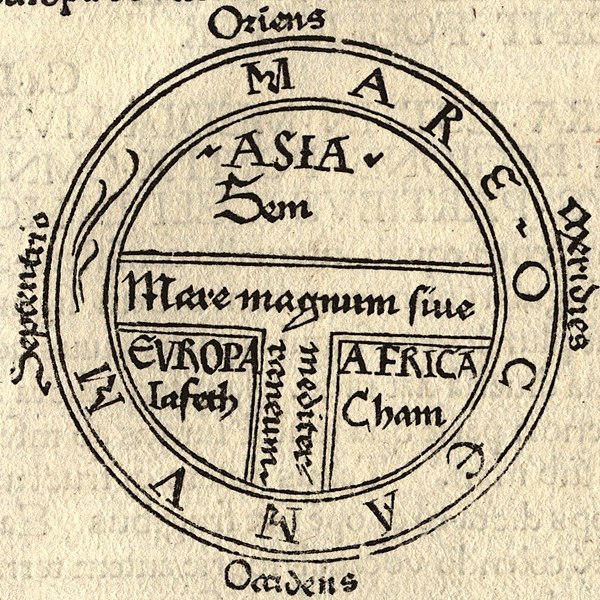
A stylised T and O map, depicting Asia as the home of the descendents of Shem (Sem). Africa is ascribed to Ham and Europe to Japheth
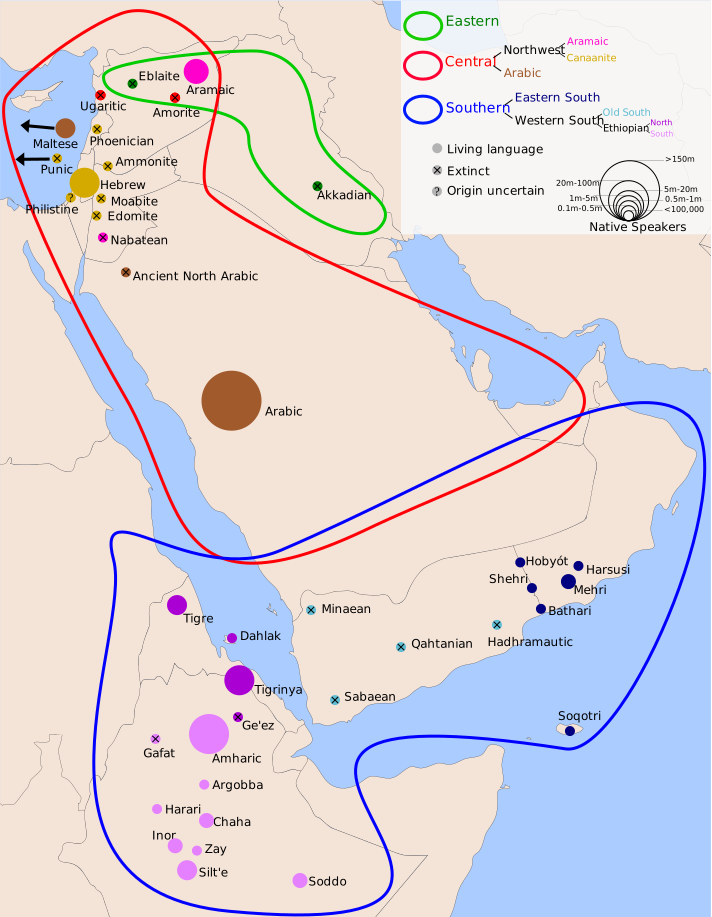
Map showing the distribution of Semitic languages
When I first learned that my blogs were to be on the Semitic civilization I thought that it would be pretty easy. I mean, when a person thinks of Semites they think of Jews don't they? But when I did a google search I was surprised what I found. Semites not only refer to Jews but to they whole region of Mesopotamia and Arabia. It turns out that the stereotype of only Jews being Semites is very recent.
The term Semitic was first suggested by German scholar Ludwig Schlozer, to signify languages that were closely related to Hebrew. The word "Semitic" is an adjective derived from Shem, one of the three sons of Noah in the Bible. The idea of "Semitic: peoples is derived from Biblical accounts of teh origins of the clutrues known to the ancient Hebrews. Those closest to them in culture and language were generally deemed to be descended from their forefather Shem. Enemeis were often said to be descendants of his cursed nephew, Canaan. In Genesis 10: 21-31, Shem is described as the father of Aram, Asshur, and Arpachshad: the Biblical ancestors of the Arabs, Arameans, Assyrians, Babylonians, Chaldeans, Sabaeans, and Hebrews, etc., all of whose languages are closely related. (Try saying this list out loud, you run out of breath pretty fast.)
The term "anti-Semitic" pretty much refers to Jews only. It was first used in 1879 by German journalist Wilhelm Marr in a pamphlet called, "The Victory of Germandom over Jewry." Marr argued that Jews who had Judaized Geramans beyond salvation. In 1879 marr founded the "League for Anti-Semitism".